
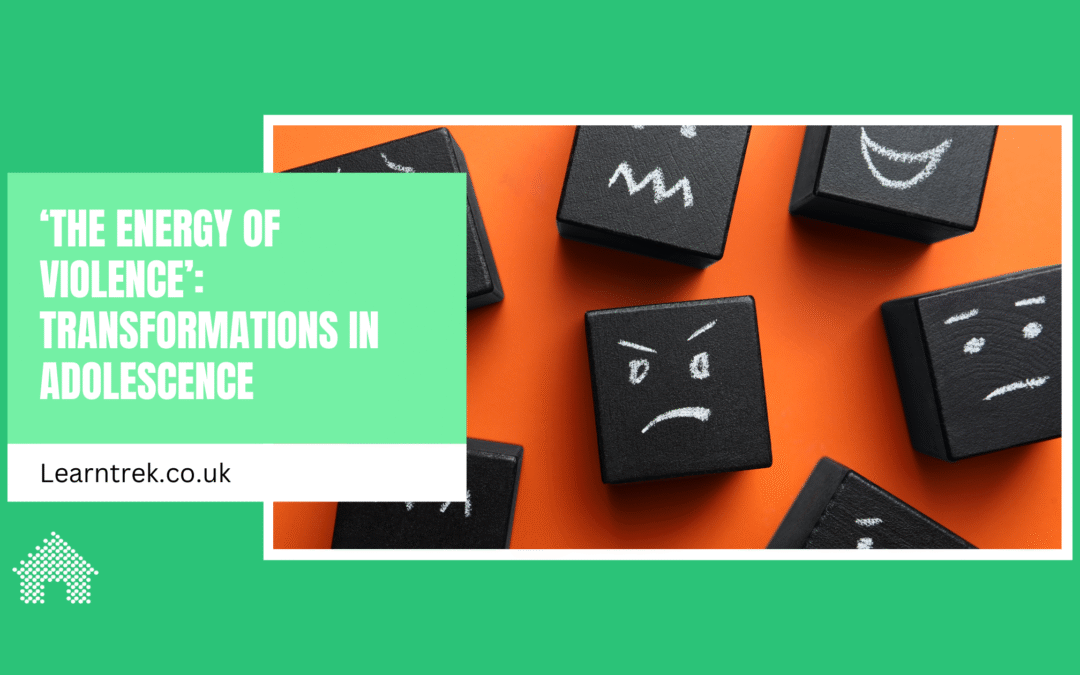
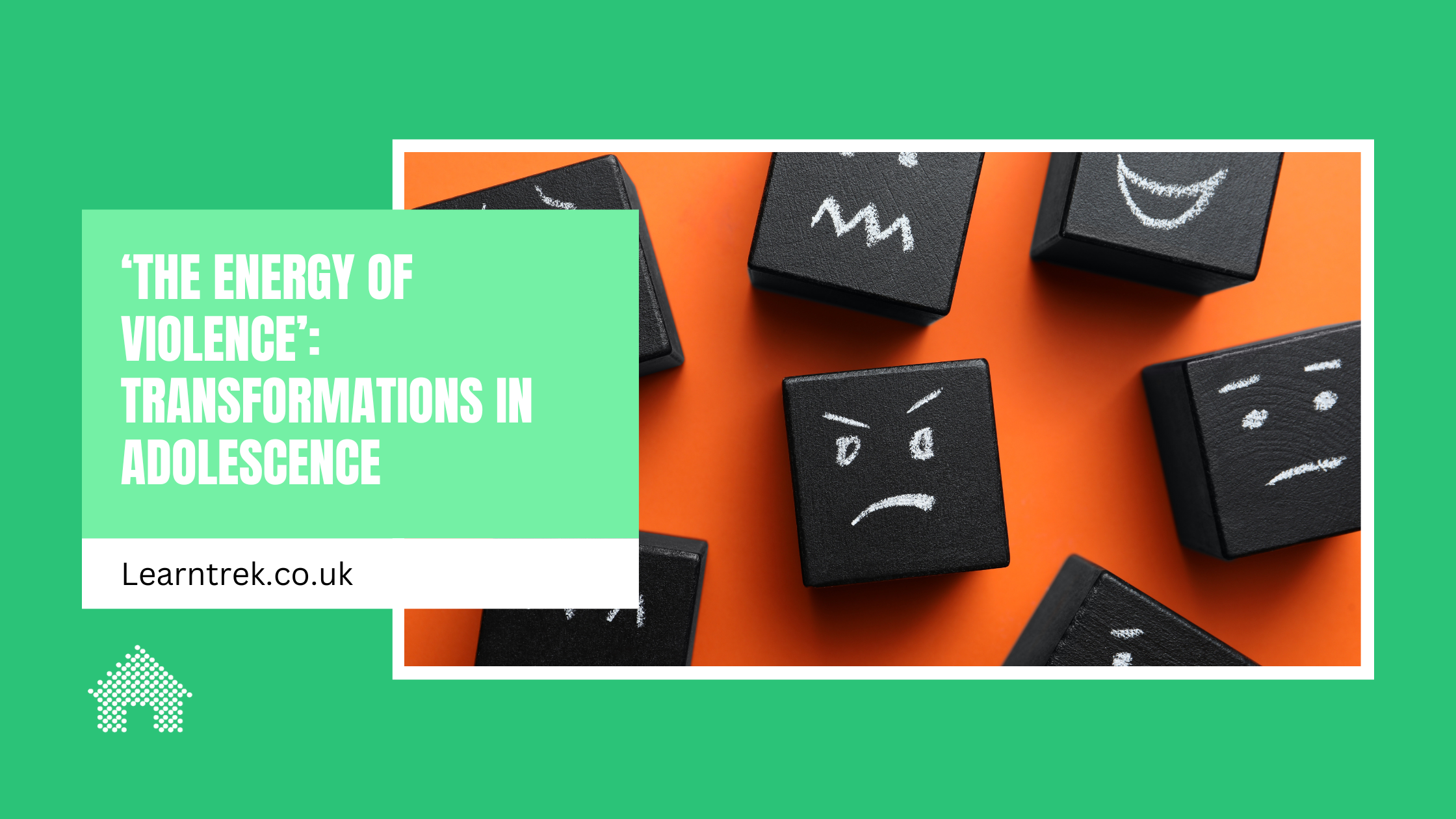
‘The energy of violence’: Transformations in Adolescence
Find Original Blog Here
In their 2023 crime survey the National College of Policing report that violence against women and girls (VAWG) accounts for 20% of recorded crime, and that reported VAWG has increased 37% since 2018 (though the actual figure may be much higher)[1].
VAWG is not confined to any social grouping, but for the purposes of this blog I will concentrate on my own area of specialism; I spent many years engaging with, and working on behaviour change, with students in alternative educational provision for children who experience social, emotional and mental health difficulties. The work brought challenges and much joy to those of us involved – personally I have been deeply affected by the humour, optimism and love of life I’ve seen in children with every reason to surrender to the impact of trauma, historic and ongoing which they experience.
The majority of young people educated in non-mainstream settings are boys[2] and, whilst I have worked with girls, it is with the male cohort where my experience has been focused, and it is here, I would argue, that work on improving outcomes around attitudes and behaviour towards women and girls is most urgent. Having spent many years designing, implementing and assessing initiatives around behaviour change, I am convinced of the generative potential of intervening during adolescence to effect meaningful and enduring change among students; this is the case in terms of the ways in which they perceive and interact with others and the world around them, and is arguably more crucial to their futures than their academic attainment.
Professor Sarah Jane Blakemore and others have produced an impressive body of work to evidence the potential in adolescence to change brain chemistry among children, regardless of the adverse childhood experiences they have been subject to. Blakemore’s work shows the way in which appropriate teaching and support during a period when the brain is ‘particularly malleable’ has the potential to help children to make choices which will have positive impact on their future life chances [3]
In my own work with boys aged between 12 and 18 I have seen depressingly high levels of casual misogyny in the attitudes they express. The rise of online influencers such as Andrew Tate has exacerbated the issues and normalized the language and ideas which boys, young men and often girls see as ‘banter’; this can range from relatively low level comments to deeply disrespectful and often threatening utterances – all of which contribute to a toxic atmosphere for women and girls. It was our responsibility as educators to create a zero-tolerance culture where warm and mutually respectful relationships could endure regardless of the challenge to attitudes and behaviour which was essential to supporting boys and young men to understand the importance of respect and consent in healthy relationships and in a safe and healthy world for everyone.
A key element of the strategy used in the school where I worked was to challenge all breaches of our rules around positive behaviour. Challenge needed to be direct, immediate and clear enough for the child to understand what was being challenged and why; challenge could be made in informal ways, relying on the relationships of warmth and trust between staff and students.
Another key component of our work on attitudes around VAWG was to deliver targeted bespoke education work promptly and shaped to the needs of groups and individuals. In creating successful interventions it is essential that systems are in place which identify problem behaviour in individuals, groups and sub-groups. To be effective our work needs to be relevant and current and to be rapidly deployed as soon as the issues are noticed. A management information system needs the capacity to recognize and analyse thematic strands of problem behaviour and attitudes; it needs to help staff tailor innovative interventions which can be delivered by engaging students without jeopardizing the relationships between staff and students upon which effective work with children and young people depends.
VAWG is one area of problem behaviour which those of us working with children need to address urgently with specialist interventions, there are many others. If encouragement were needed for institutions working with children and young people to identify and focus on attitudes and behaviours towards women and girls, the Office of National Statistics summary provides sobering evidence:
Crimes which disproportionately affect women and girls, such as sexual violence, domestic abuse, and stalking have devastating consequences. .. considering some of the less hidden crimes, we estimate 1 in 3 women over the age of 16 in Great Britain were subjected to at least one form of harassment in the last year. This increases to 2 in 3 for women aged 16 to 34.[4] (My emphasis)
The Netflix series Adolescence[5] has brought to the fore in recent weeks the impact of misogyny on the lives of children, families and communities. I don’t particularly want to add my voice to the chorus of comments about this deeply affecting piece; however, I do think it’s important to keep in view the potential to shape young minds in positive ways, and against the barrage of harmful ideas and language which bombard them. In my experience it is possible to offer alternative views and embed respectful ways of being. Those who work with children and young people must build authentic adult/child relationships where mutual respect and trust are established and maintained. This means having integrity as the adult, creating healthy boundaries and being willing to challenge, even at the risk of being unpopular; it means being proactive and success-orientated and creating environments where children and young people can make positive choices. [6]None of this is easy, but the consequences of abandoning the effort at this point are unthinkable for women and girls, for boys and young men, and for the world at large.
[1] Crime Survey 2023, National College of Policing
[2] Ofsted Investigative Report into Alternative Provision, 2018 notes that over 70% of pupils in Pupil Referral Units, unregistered AP and independent special schools are boys from impoverished backgrounds
[3] Blakemore, S-J, Inventing Ourselves: The Secret Life of the Teenage Brain, London 2018, p.95
[4] Elkin, M, ‘Violence against women and girls: Helping ot understand the scale and impact of the problem’, Newsletter of the office of National Statistics, November 2021
[5] For a discussion of ‘being the adult’ in professional relationships wtih children, see Bluestein, J, The Win-Win Classroom: A Fresh and Positive Look at Classroom Management, Thousand Oaks, 2008
[6] Adolescence, Thorne J, Graham S, Netflix, 2025
