
The Portability Crisis: Navigating Multi-Agency Data under the New AP Tiers

The Portability Crisis: Navigating Multi-Agency Data under the New AP Tiers

The new White Paper changes where and how long a student stays inside an Alternative Provision (AP). With Tier 1  focusing on rapid outreach and Tier 2 on short-term reintegration. EOTAS package current status quo is split across multiple bespoke venues, a student's education is no longer contained within four walls.

The immediate operational risk is data fragmentation. When a child moves between a mainstream school, an outreach worker, an online learning platform, and a physical AP setting, their progress data usually lives in three different spreadsheets, two or more software systems, and a paper folder. Under the new national standards, that administrative mess is a massive compliance liability.


Mainstream schools and LAs can be slow to transfer accurate student histories (safeguarding flags, academic levels and baselines, behavior triggers) when a student enters a time-limited Tier 2 placement or needs Tier 1 outreach. APs can waste weeks trying to figure out a child’s baseline, cutting into precious intervention time.
LearnTrek acts as an onboarding and transition portal. Because the platform allows for restricted, tier-based user permissions, APs can grant external mainstream staff or LA commissioners direct, secure access to inputs. You can build a standardised, digital transition gate where baseline data must be completed before or at the exact moment of placement, ensuring zero lag time in supporting the child.


Under the new standards, tracking attendance for Tier 2 (short-term) or complex EOTAS packages is a high-stakes safeguarding pressure point. If a child is under shared attendance or accessing an off-site package, the legal responsibility for tracking safety is shared. Currently, this looks like administrative teams wasting the first two hours of every morning making phone calls and cross-referencing registers to ensure a child arrived safely.
LearnTrek’s Live Attendance Dashboard and Automated Alerts take the friction out of shared placement tracking. When an off-site tutor or an AP practitioner logs attendance on LearnTrek, the data updates instantly. If a student fails to show, automated triggers can instantly alert the designated contacts across both the AP and the commissioning school. It changes attendance from a reactive paper trail into an active safeguarding shield.


The entire goal of the White Paper’s Tier 2 model is rapid, successful reintegration back into the mainstream. But when a placement ends, how do you prove the student is ready? Sending a mainstream school a massive, messy history of daily case notes is useless; busy class teachers won't read it, the strategies get lost, and the reintegration fails.

Instead of raw data dumps, LearnTrek allows you to generate a clean, high-impact Reintegration Export. This pulls together the critical trend lines; showing exactly how behavior incidents decreased, how engagement rose, and the specific teaching or regulatory strategies that worked. You hand the mainstream school a definitive, evidence-backed user manual for that child's ongoing success, proving the absolute value of your AP's intervention.

APs that continue to rely on siloed, rigid mainstream MIS platforms or home-grown spreadsheets are going to find themselves trapped in a logistical nightmare of administrative latency, fractured safeguarding records, and invisible progress metrics.
The settings that thrive under this new regime will be the ones that recognise that data portability is the bedrock of modern safeguarding and commissioning. By utilising a platform built explicitly for the messy, non-linear realities of specialist education, LearnTrek allows providers to break down the silos between mainstream schools, local authorities, and outreach teams.
Beyond Compliance: Why the SCR is key to unlocking compliance in Alternative Provision.

Beyond Compliance: Why the SCR is key to unlocking compliance in Alternative Provision.

In Alternative Provision, the wide range of staff types, from full-time teachers to specialised mentors and external contractors, makes maintaining a  Single Central Record (SCR)  a highly complex process. You have to know exactly which regulations and compliance requirements apply to which role, and those regulations, like those updated in annual changes to KCSIE, change almost every year.

One of the central tenets of the new National Standards for Alternative Provision is the SCR as a requirement to evidence safer recruitment. In an environment where students often require the highest levels of support and protection, and the increased focus on regulatory oversight in AP there is zero margin for error.

Why the "Independent School Standards" may offer a  the New Benchmark for AP

Registered non-maintained settings who work with similar cohorts of children and young people to NSAPs, such as independent special schools, are already required to meet safeguarding and safer recruitment obligations as set out in the Independent School Standards. Arguably, NSAPs’ obligations to do the same have always been clear within the legal framework set out in KCSIE and Working Together to Safeguard Children. The new National Standards for (Non-School) Alternative Provision strengthens and foregrounds this.

The government’s guidance on regulating independent schools also makes clear that safeguarding is not a "best practice" suggestion; it is a legal requirement for school registration. While non-school APs do not necessarily work to the exact same set of standards as these schools, the proposed National Standards set out that the same expectations around recording staff checks apply to both types of setting.
Equally, while independent special schools risk inspection failure if they fail to appropriately record staff checks and compliance with statutory duties, NSAPs who fail to produce accurate records evidencing how they meet the National Standards in a range of areas, including their SCR, risk criminal prosecution for operating an unregistered school.

While the necessity of a robust SCR is clear under the new National Standards, the reality of maintaining one manually is increasingly difficult for Alternative Provision leaders. Many providers currently find themselves trapped in a cycle of "manual management," where fragmented data is scattered across disconnected spreadsheets and overflowing paper files. This fragmentation creates a dangerous vacuum where human error regarding expiry dates for DBS renewals,ID checks and staff training can easily slip through the cracks.
In an environment already defined by time poverty, every minute a staff member spends chasing a missing certificate or cross-referencing a training log is time stolen from the frontline support of vulnerable learners. To meet the rigorous expectations of the DfE and the Independent School Standards, APs must move away from these high-risk, labour-intensive methods and toward a digital architecture that automates the burden of proof.

In an era of increasing cyber-security risks, LearnTrek has spent time engineering a system where information risk is mitigated at every level, from encrypted cloud storage to our secure "Doc Link" architecture. We are proud to announce that SCR Management has arrived at Learntrek, providing a hub that is as secure as it is simple to use.

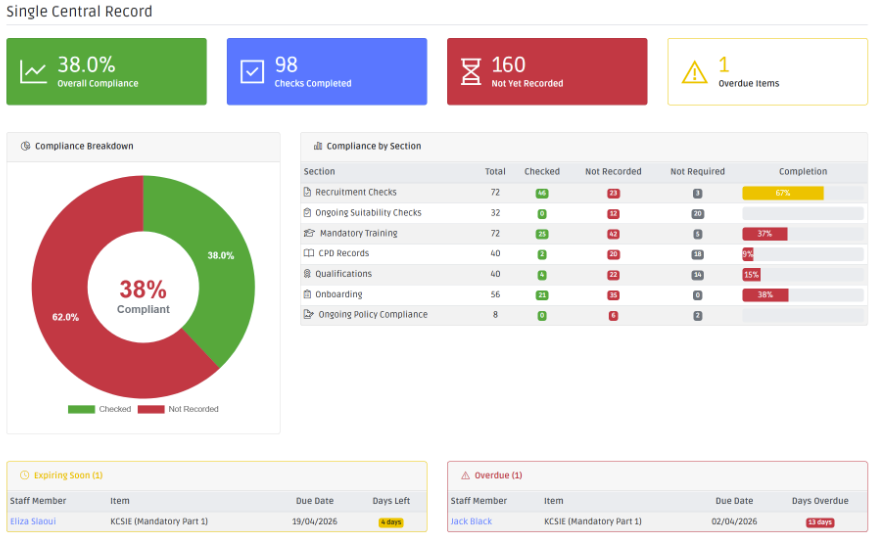
Our new update (as of April 2026) contains three new areas on Learntrek to hold as much information about staff compliance as possible in one location. An SCR Dashboard (pictured above) and a staff list that links to  individual staff records displays the progress of  individual staff members as well as the entire setting.

The shift toward sector-wide National Standards that sit alongside and overlap with the Independent School Standards is a transformative moment for Alternative Provision. It is a clear signal that the safety and vetting of our workforce must be as robust as any mainstream or maintained education setting. Arguably this has always been the case, and the best settings have ensured it. However, as the regulatory bar rises, the tools we use must rise to meet it.

By centralising your compliance into our new SCR Dashboard and providing individualised staff progress trackers, you can reduce manual management and reclaim your time and peace of mind. You can operate using a single source of truth that secures your data, automates your checklists, and ultimately protects your provision from the risks of non-compliance.

In the high-stakes environment of AP, there is no room for "good enough." With Learntrek, you can move forward with the confidence that your safer recruitment process is more than just a policy; it is a live, secure, and permanent shield for your staff and students alike.

Revolutionising Alternative Provision: How Learntrek is Digitising the ILP

Revolutionising Alternative Provision: How Learntrek is Digitising the ILP

In the Alternative Provision (AP) sector, being adaptable is in everything we do. A major shift is coming that requires more than just adaptability - it requires a digital transformation. 

Following the Voluntary National Standards published in August 2025, the Government has made its trajectory clear: while these standards are currently voluntary, they are the blueprint for a new legal framework. With an act of Parliament expected in the Spring 2026 parliamentary session, these standards are set to become mandatory.

At Learntrek, we have been watching this closely. We are proud to be one of the first software companies to provide a dedicated ILP (Individual Learning Plan) module that specifically answers these new requirements.

From "Induction Plans" to "Joint Plans"

While the new standards don’t always use the specific term "ILP," the Government’s own guidance for commissioners (issued February 2025) is much more explicit. It outlines that every placement should be governed by what they call an "Induction Plan" or a "Joint Plan."

Whatever name you give it, the requirement is the same. A document that outlines:

  • The baseline of the student.
  • The specific, individualised targets for their placement.
  • A clear strategy for progress and reintegration.

As these standards move from voluntary guidance into statutory law in 2026, paper forms and basic spreadsheets won't be sufficient. To remain on a local authority’s commissioned list, providers will need to demonstrate that their progress tracking software can handle these "Joint Plans" and provide full transparency and easy access.

Why "Progress Tracking Software" is the Key to 2026 Compliance

The government's response to the Strengthening Protections in Non-School Alternative Provision consultation highlights a push for better oversight. You cannot provide "oversight" without adapting to ensure your tech systems are ready to meet the moment.

By using Learntrek’s progress tracking software, your ILPs/Joint Plans become a powerful tool for compliance:

  1. Alignment with National Standards: We have built the August 2025 standards directly into our architecture.
  2. Instant Commissioner Reporting: When a Local Authority asks for evidence of the "Joint Plan," you can generate a professional, data-backed report in seconds.
  3. Real-Time Progress: Unlike a paper Induction Plan that sits in a folder, a Learntrek ILP updates as the student progresses, providing evidence from day one.

Learntrek: One of the First to Bridge the Gap

We recognized early on that the transition from the February 2025 guidance to the Spring 2026 mandatory standards would be a headache for providers. That’s why we have worked to become a market leader in this space.

LearnTrek is one of the first software providers to offer a solution that specifically facilitates these mandatory changes. We don’t just track attendance; we track the journey specified in your statutory Joint Plans.

Future-Proof Your Provision

The shift is coming. The move to mandatory standards is a chance for high-quality AP providers to prove their value through better data and clearer student outcomes. Don't wait for the Act of Parliament to de-rail your provision in 2026. Start building your digital "Joint Plans" today with a system designed for the future of Alternative Provision.

Documentation shouldn’t be a factor APs should be prioritising. Learntrek prioritises it for you so students are alternative provision’s main focus. The jump to mandatory will come as an uncomfortable change for some communities, if not kept up to date. Learntrek strives to be at the forefront of the change.

MFA for Alternative Provision: Closing the School Cyber-Gap

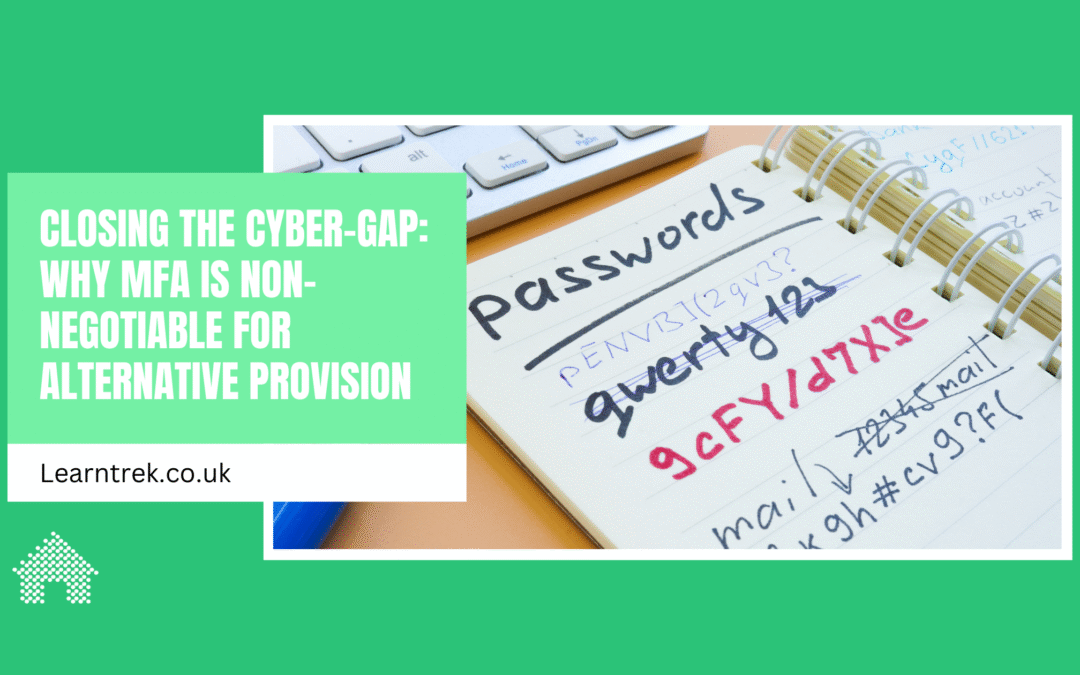
MFA for Alternative Provision: Closing the School Cyber-Gap

The Nation Cyber Security Centre warned us that MFA-targeted attacks were coming. The 2025 data proves they are here.

The Funding Gap in School Security

All parts of the education sector investigated by NCSC were found to have a higher percentage of cyber attacks than the 43% level experienced by  businesses across all sectors. Although Primary Schools and Secondary Schools were the lowest of the education sector, they nevertheless reported 44% Primary and 60% Secondary attacks or breaches in the last year (as of mid 2025). The most common form of cyberattacks was phishing, impersonation and viruses/spyware/malware. All forms of these attacks cause risk of interfering with children's education and Alternative Provision support.

External sources of support can help to lessen the  number of breaches. Multi-Factor Authentication (MFA), for example, is an extra layer of security for educational institutions to keep their information safe. The National Standards for Non School Alternative Provision will mark a change for alternative provisions and how they are expected to work. Section 3 of the standards focuses on admissions, support and guidance, requiring private information to be well protected in line with GDPR.

While larger schools and academies have the safety net of larger trust-wide budgets, expertise as well as access to government funded schemes and support; Alternative Provisions often operate on the front lines with fewer resources. This creates a 'security gap' that cyberattackers  are eager to exploit. At Learntrek, we don’t believe your students’ data should  be less secure just because your setting is smaller. We’ve designed our platform to bridge that gap - giving you the same 'lock-and-key' protection used by major institutions, but tailored specifically for the unique workflow of an AP.

What is MFA?

A verification method of multiple security methods and options. Passwords, passwordless MFA and a code provided by an app or biometric authenticator being the most common.

We Can Help

At Learntrek we  offer MFA free of charge in our software as we don't believe security should be an add-on. Data is securely hosted by Amazon Web Services, and we provide a range of cyber security measures including cyber security scanning alongside MFA. Registered with the UK Government’s Cyber Essentials programme, we make it as clear as possible that we value security of the students and staff first. Our databases allow a restricted line of access to specific individuals, and cybersecurity is a core part of Learntrek handling sensitive information.

Empowering Your Team

It can be overwhelming to keep up with the constant security updates required to battle modern cyberattacks. That is why we don’t just provide the software; we provide the knowledge. We offer comprehensive staff training (via support videos, training calls, or face-to-face sessions) to help your team understand and navigate your security system with confidence.

Moving Beyond the Spreadsheet

Whether you are currently using cloud backups or a simple Excel spreadsheet, we know that tackling admin and security can feel like a mountain to climb - especially with smaller teams.

Learntrek is designed to be flexible and customizable, adapting to the specific security measures your institution needs to remain compliant. While MFA usage is increasing across the education sector, we want to ensure Alternative Provisions are not left behind. By handling vulnerability management seamlessly, we allow you to focus on  the needs of your students rather than anxieties about technical compliance.

Secure Your Provision Today

Cybersecurity shouldn't be a luxury reserved for the biggest budgets. It is about protecting the personal data of the young people in your care.

Ready to see how Learntrek can protect your setting? If you have questions or would like to see a demo of our MFA and security features in action? Complete our contact form. A member of our team will get back to you within 24 hours.